
Disability, Accessibility and Inclusion
It is essential that all hospital workers have a strong understanding of disability, accessibility and inclusion. Press play to learn from Joel, Bianca, Andrew, Michael and Bryce as they explain Disability, Accessibility and Inclusion and the ways they interact with each other.
Download the transcript for Defining Disability Accessibility and Inclusion
Click on the accordion below to learn more and identify your responsibilities as hospital workers in promoting disability accessibility and inclusion.
Disability
The United Nations Conventions on the Rights of Persons with Disabilities states that all hospital staff have a responsibility to ensure that people with disability can access the highest standard of healthcare without risk of discrimination (United Nations 2006). To do this, disability inclusion must be considered at the forefront of hospital practices and processes (World Health Organisation 2022).
Disability can be physical and non-physical, visible and non-visible.
The Australian Bureau of Statistics Survey on Disability, Ageing and Carers (2018), groups disability in a broad context. Disabilties may be identified within one group or may fit within many groups.
The six disability groups include:
- Sensory and speech (sight, hearing, speech)
- Intellectual (difficulty learning or understanding)
- Physical (such as breathing difficulties, chronic or recurrent pain or incomplete use of limbs)
- Psychosocial (including psychological conditions, mental illness, memory problems and social or behaviour difficulties)
- Head injury, stroke or acquired brain injury
- Other (restrictions in everyday activities)
(Australian Institute of Health and Welfare 2022)
 Did you know that 90% of disability is non-visible and that 4.4% of people with disability are wheelchair users?
Accessibility
Accessibility is about understanding the diverse needs of our society and making sure we work to support those requirements to create equal and equitable access in all aspects of life.
Accessibility allows people with disability to do what they need to do with a similar amount of effort and time as someone without disability.
It involves making products, services, physical environments, training and development, digital technologies, communications and information services available for use by someone with disability.
Accessibility alone does not meet the needs of people with disability.
Inclusion
Inclusion is about being involved and actively participating.
It's about the unique experiences, opinions and ideas of all people being respected, heard and considered.
In order to be inclusive, it's important to have an open mindset, which means that decisions are made with all people in mind.
As hospital workers, it's important to remember that people, like you, are the main drivers for the facilitation and involvement of people with disability.
In the hospital setting, it's important that people with disability can not only access the physical environment, but that they feel respected and included in discussions regarding their healthcare.
There is a strong connection between accessibility and inclusion. Sometimes, when explaining their interaction, they are referred to as hardware and software. Hover your mouse over the below infographics to identify examples of the hardware and software of accessibility.
Hardware helps people with disability get into the room but it’s the software that helps people with disability stay there.

Hardware accounts for the physical accessibility measures required to get
from place A to place B. This includes ramps, heigh adjustable furniture and unobstructed paths of travel.
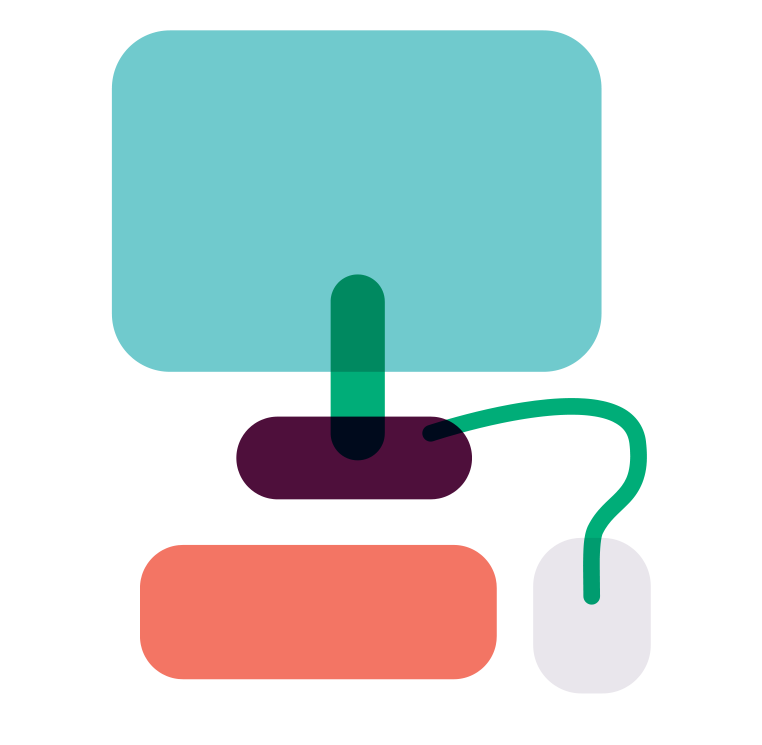
The terms software refers to societal attitudes, behaviours and language.